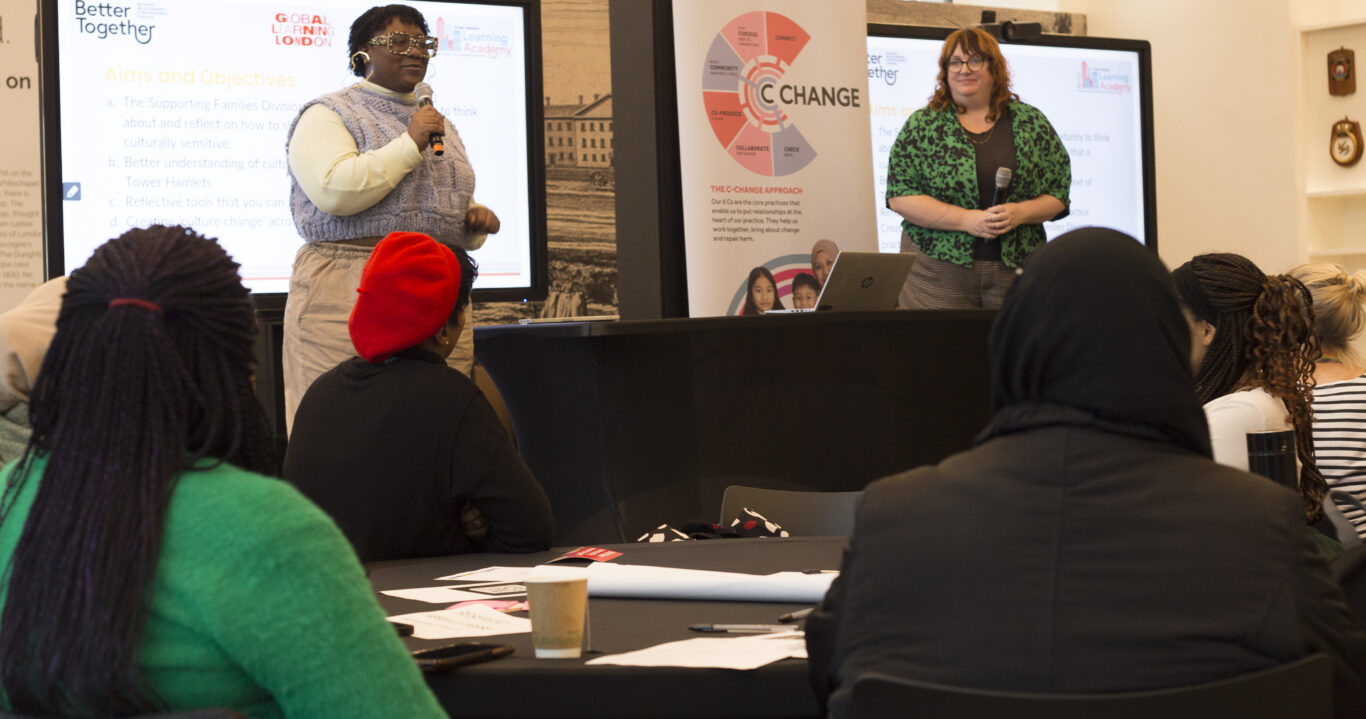


Conference: Culture, Identity and Anti-racism
While we exist alongside each other in such diverse communities, such as our base in Tower Hamlets, we are frequently fed narratives that isolate us from each other, ingraining stereotypes into our consciousness. To interrupt these stereotypes goes far beyond learning ‘this is a stereotype, I shouldn’t think that’. It requires an ongoing, active practice of questioning, unlearning and relearning.
In November 2025, we delivered a conference on Culture, Identity and Anti-racism for the entire Tower Hamlets Supporting Families Division team, to reflect on how we can show up for children and families in a culturally sensitive way.
Through an anti-racist lens, we walked through the history of Tower Hamlets, the global factors that have impacted how we see culture and religious identities in the area, and how these wider narratives impact how communities are viewed or stereotyped.
Our brilliant facilitators, Beth Allum and Germma Orleans-Thompson, guided the teams through discussions and exercises to reflect on our own biases and understand how our conditioned tendencies and unconscious biases arise under pressure. We explored practices of self-examination to realise those processes, and practical strategies to support ourselves as individuals, and each other as peers and colleagues, in considering how we show up through support, care and sensitivity when working with communities.
We closed with a panel of Senior Leaders from the Supporting Families Division, who reflected on the strategies they are putting in place to support the wider team in creating safe and supportive spaces to discuss concerns, unpick cultural bias, and actively practice anti-racism in their work.
Thank you to the Culture, Identity and Anti-racism working group from the Supporting Families Division, Latifa Akay and Dr Fatima Rajina, who all played an important role in bringing the conference together, and to everyone who joined us and took part as an ongoing commitment to embedding anti-racist practice within their work in helping some of the most vulnerable children and families.

